For hotel, homestay and short-stay operators, WhatsApp has become part of everyday guest communication.
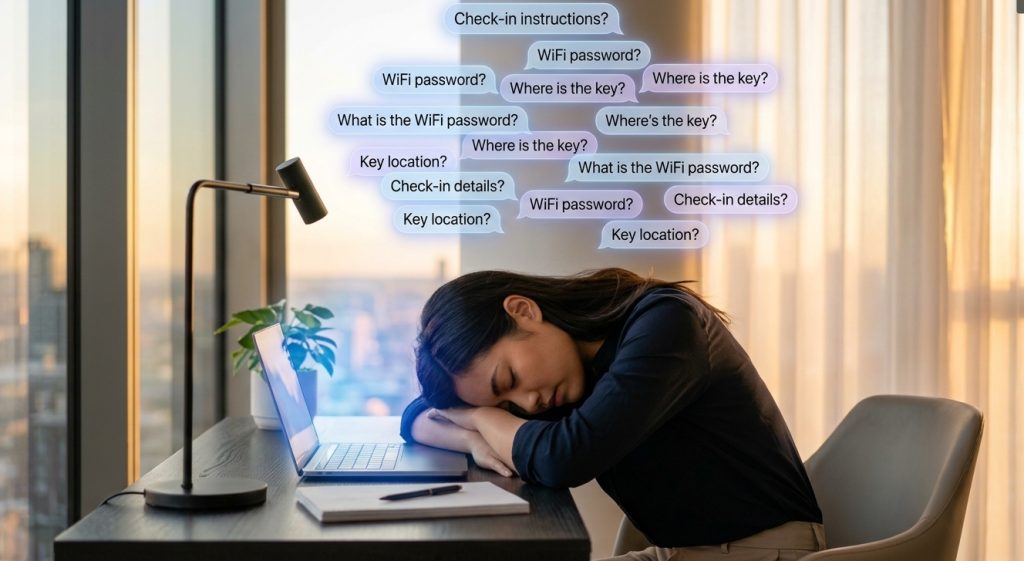
A guest asks about check-in. Another asks for the WiFi password. Someone else wants to know where to collect the keys.
The questions may be simple, but when the same questions appear every day, replying to them manually can take up a surprising amount of time.
With changes to WhatsApp messaging costs, it is also worth looking at what messages you are sending, when you are sending them, and whether every message needs to be handled manually.
The goal is not simply to send fewer messages.
It is to send smarter, more useful messages while making daily operations easier.
Start by Looking at Your Repetitive Messages
Before thinking about automation, look at the messages your team sends most often.
For many accommodation operators, these may include:
- Booking confirmation information
- Check-in instructions
- Access or key collection details
- WiFi information
- House rules
- Parking instructions
- Check-out instructions
- Directions to the property
- Frequently asked questions
These messages usually contain information that does not change from guest to guest.
That makes them good candidates for automation.
Instead of having your team repeatedly copy and paste the same information, you can prepare the information once and trigger it at the appropriate stage of the guest journey.
Use Automated Messages for Information Guests Need at the Right Time
Automated messages can help deliver information based on events or stages in a booking.
For example:
Booking confirmed → Send booking information
Before arrival→ Send check-in instructions
During stay→ Send useful property information
Before departure → Send check-out instructions
This creates a more structured communication flow.
With a platform such as Janus Digital, operators can set up scheduled guest messages so that the appropriate information is sent automatically.
The operator does not need to manually send the same message every time a new booking arrives.
The important point is that automation should follow your operating process.
If your SOP is unclear or contains unnecessary steps, automating it will not automatically make the process better.
Simplify the process first. Then automate it.
Not Every Guest Question Should Become Another Manual Reply
Automated messages are useful for information that you already know.
But guests will still ask questions.
For example:
“Can I check in at 3pm?”
“Where should I park?”
“Is the swimming pool open?”
“How do I get the key?”
This is where an AI Chatbot can help.
Instead of treating every question as a completely separate conversation, an AI Chatbot can use the available property information and conversation context to provide a more relevant response.
For operators, the benefit is not simply having a chatbot answer questions.
It is about reducing repetitive back-and-forth.
A guest may ask several related questions in the same conversation. Rather than requiring the operator to manually piece together the answers each time, the AI can help consolidate the relevant information into a response.
Collect More Information in One Go with WhatsApp Flows
Another common source of repetitive messaging is information collection.
For example, an operator may need to ask:
Question 1: What time will you arrive?
Question 2: How many guests are staying?
Question 3: Do you need parking?
Question 4: Do you need any special arrangements?
Asking these questions one by one creates more messages and more opportunities for the guest to stop responding.
With WhatsApp Flows, operators can create an interactive form-like experience inside WhatsApp.
The guest can provide several pieces of information in one interaction.
For example:
Arrival Time: 3:00 PM
Guest Count: 4
Parking: Yes
This can make information collection more structured for both the guest and the operator.
Think About the Whole Guest Communication Journey
The real opportunity is not one automation feature.
It is how different tools work together.
A simple guest communication journey could look like this:
Booking Confirmed
↓
Automated booking message
↓
Before Arrival
↓
Automated check-in instructions
↓
Guest Has a Question
↓
AI Chatbot handles common questions
↓
Guest Information Needed
↓
WhatsApp Flow collects details
↓
Human Help Needed
↓
Operator or team member takes over
This creates a more structured communication process instead of relying on someone to manually monitor and answer every message.
WhatsApp Cost Is Only One Part of the Picture
When messaging costs change, it is natural for operators to look at their WhatsApp usage.
But cost should not be the only consideration.
A message that provides important check-in information may prevent a guest from asking the same question again.
A well-timed automated message may reduce unnecessary back-and-forth.
A structured WhatsApp Flow may collect several pieces of information without requiring multiple individual questions.
And an AI Chatbot may help handle common questions without requiring a team member to respond to every conversation manually.
So the better question is not:
“How can I send fewer messages?”
It is:
“How can I make each guest interaction more useful?”
Automation Should Make Operations Simpler
For accommodation operators, automation should not mean adding more complicated technology to daily operations.
It should do the opposite.
The ideal process is simple:
Identify repetitive work → simplify the process → automate what can be automated → hand over exceptions to a human.
For example, if 80% of guest questions are common questionsand 20% require special attention, automation can help handle the repetitive part while allowing your team to focus on situations that actually need human involvement.
That is where tools such as automated messages, AI Chatbots and WhatsApp Flows can work together.
A Smarter Way to Manage Guest Communication
WhatsApp remains an important communication channel for many hospitality operators.
As messaging costs and operational demands change, it is useful to review how your guest communication works.
Start with the simple questions:
Which messages do we send repeatedly?
Which information can be sent automatically?
Which guest questions can be handled using existing property information?
Which information do we repeatedly collect from guests?
Which conversations actually require a human?
You may find that the answer is not simply sending fewer messages.
It may be about sending the right information at the right time, collecting information more efficiently, and reducing unnecessary manual work.
For operators looking to structure and automate their guest communication, Janus Digital brings automated messages, AI Chatbot conversations and WhatsApp Flows together as part of a more streamlined guest communication workflow.