Short-stay platforms such as Airbnb can create new challenges for Joint Management Bodies (JMBs) and building management offices.
Guests come and go, hosts may use different check-in methods, security guards receive repeated questions, and management teams may struggle to keep track of who is entering the building.
The challenge is not simply about having rules.
The bigger challenge is making those rules part of a consistent daily process.
From Rules to Daily Operations
A JMB can establish building rules for short-stay activities, but enforcement becomes difficult when every host manages guests differently.
For example:
- One host may send access instructions manually.
- Another may ask guests to collect keys from security.
- Some guests may arrive without complete information.
- Security guards may need to call hosts for confirmation.
- Vehicle information may not be available before arrival.
- Management may only discover a problem after an incident happens.
This creates more work for security and management teams.
A better approach is to create a standard process that every host follows.
A Simple JMB Short-Stay Process
A building can structure the process around several key steps:
Host Registration
Hosts provide the required information to the JMB or management office.
This can include unit details, host contact information and other information required by the building’s rules.
Guest Information
Before arrival, the required guest information is collected through a standard process.
Instead of asking security guards to repeatedly collect information through phone calls or WhatsApp messages, the process can be handled digitally.
Guest Verification
The required information can then be checked before access is provided.
This gives security personnel a clearer process to follow instead of making decisions differently for every guest.
Access Instructions
Once the required conditions are met, the guest receives the relevant check-in and access information.
This could include:
- Building entry instructions
- Parking information
- Unit information
- Access instructions
- House rules
- Key or access-card collection
- Smart locker or smart lock instructions
Building Access
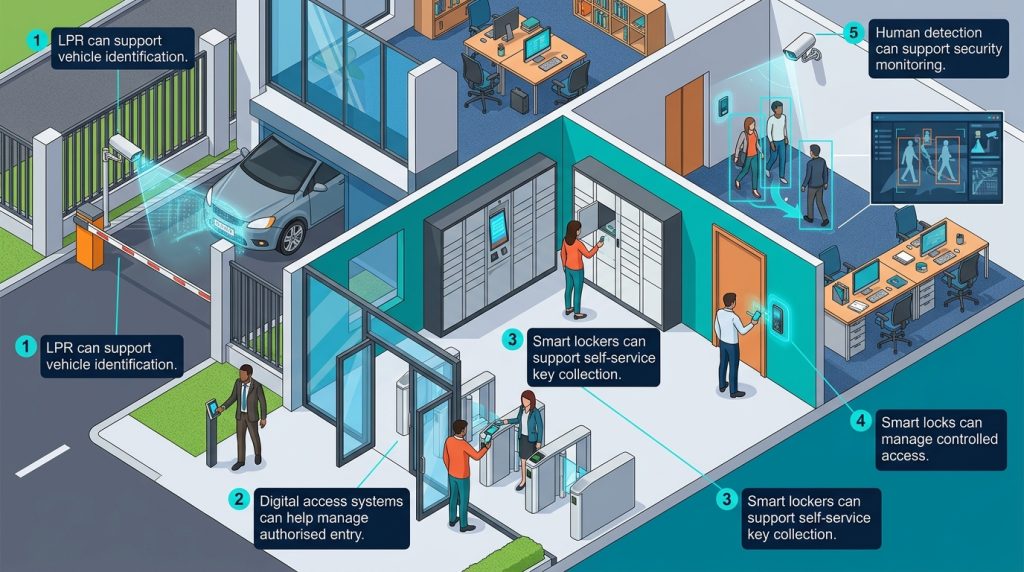
The process can also work together with the building’s existing smart security technology.
For example:
- LPR can support vehicle identification.
- Smart locks can manage controlled access.
- Smart lockers can support self-service key collection.
- Human detection can support security monitoring.
- Digital access systems can help manage authorised entry.
The technology performs its specific function.
The process around the technology is what makes it useful operationally.
Where Janus Fits
Janus Digital can act as the process and automation layer connecting the host, guest, management team and building technology.
For example:
Host registers booking
↓
Guest information is collected
↓
Required verification is completed
↓
Janus sends the appropriate WhatsApp instructions
↓
Guest arrives at the building
↓
LPR / security process verifies access
↓
Smart locker or smart lock provides access
↓
The activity is recorded for operational reference
This means the JMB does not need to manually coordinate every step.
Janus does not replace the JMB’s authority or security team. Instead, it helps turn the building’s rules into a repeatable operational workflow.
Making Enforcement More Consistent
Enforcement becomes easier when everyone follows the same process.
Instead of security asking:
“Who is this guest?”
The process can provide a clearer answer:
Is the host registered?
Is the guest information complete?
Has the required verification been completed?
Is the vehicle authorised?
Is access allowed?
This reduces unnecessary back-and-forth between guests, hosts, security, and management.
It also creates a clearer record when an issue occurs.
Smart Technology + Smart Process
Installing an LPR camera, smart lock or smart locker is only one part of building smarter security.
The bigger question is:
What happens before and after the technology is used?
A smart locker can store a key, but the process still needs to determine:
- Who is authorised to collect it?
- When can they collect it?
- How do they receive the instructions?
- What happens if verification fails?
- What happens if the guest cannot access the locker?
This is where process design becomes important.
Smart technology provides the capability.
Smart processes make that capability work in daily operations.
Building a More Organised Short-Stay Environment
For JMBs and Management Offices dealing with short-stay hosts, the goal is not simply to add more rules or more technology.
The goal is to create a clear, standardised process that hosts, guests and security can follow.
Janus Digital helps build and automate these processes around existing building systems — from guest communication and information collection to access instructions and operational workflows.
The result is a more structured approach to short-stay management:
Clear Rules → Standard Process → Automated Communication → Smart Access → Better Operational Control
For JMBs, this can mean less repetitive work, fewer unnecessary interruptions and a more consistent way to manage short-stay activity.
Smart technology is only the beginning.
The real difference comes from the process built around it.